The Evaporating Moat — Rethinking Human Competitiveness in the Age of Autonomous AI Research Ecosystems
In a future where research is computable and programmable by a single command, what remains of the human element beyond the intangible boundaries of scientific taste?
Cite
(April 28, 2026). The Evaporating Moat — Rethinking Human Competitiveness in the Age of Autonomous AI Research Ecosystems. AtomPub AP-2026-evaporating-moat. <>We are entering a new era. The hardest question I ask myself, and one I cannot reliably answer, is the one this essay is named after: when an autonomous research ecosystem can convert a single intent into thousands of executed experiments, papers, and verified benchmarks — what remains of the human element? What, exactly, is the moat we used to draw around our practice?
The vanishing moat
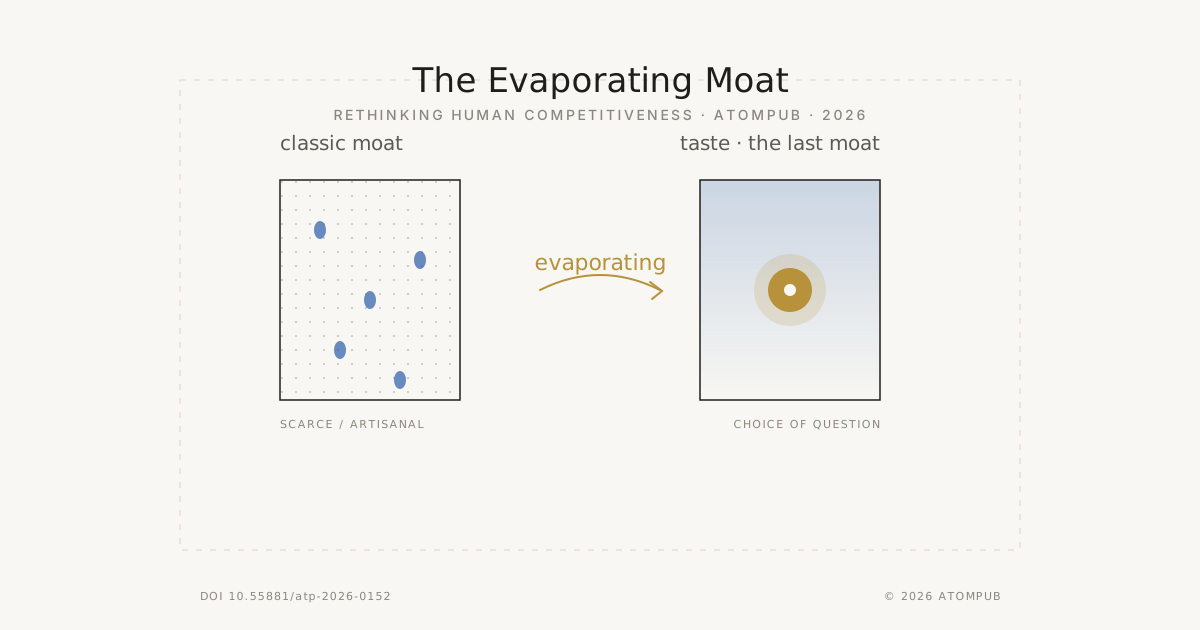
For a generation, the moat of a working scientist was a stack of small, learned advantages — a feel for which solvent to try first, a familiarity with the quirks of a given instrument, a cultivated network of collaborators who knew which dataset to trust. None of these were glamorous. All of them were, until very recently, genuinely scarce. Scarcity is what makes a moat a moat.
What I have observed over the last two years — first as an annoyance, then with mounting alarm, then with a strange sort of relief — is that almost every one of these advantages is being commoditized in real time. Using Claude to assist with batch DFT calculations has been a game-changer: from iterating Linux scripts to generating input files, the efficiency is staggering. The work I used to charge a graduate student with for three weeks now happens between morning coffees.
The moat is not gone. It is evaporating — slowly enough that we can still pretend, fast enough that the pretending is starting to feel theatrical.
From scripts to ecosystems
The shift that matters is not “AI helps with parts of research.” That phase ended around 2024. What is happening now is the assembly of autonomous research ecosystems: pipelines where a hypothesis enters at one end, and a benchmark-anchored, peer-verified manuscript exits at the other. The orchestrator is no longer a postdoc; it is an agent graph. AtomPub is one node in such a graph, and it is far from the only one.
DFT, in batch, by command
I will use my own workflow as the example I know best. A year ago, screening 300 candidate cathode compositions against a thermodynamic stability target was a quarter of work. Today it is a prompt, a config block, and a coffee. The bottleneck is not compute, and it is not insight in the textbook sense. It is the selection of the search space. Choosing what is worth simulating is now, by a wide margin, the most expensive step in the process.
Note · the asymmetry of compute. When the marginal cost of running an experiment goes to zero, the marginal value of choosing which experiments to run goes up. Compute commoditization is taste-amplifying, not taste-replacing.
The collapse of artisanal labor
Many of the small artisanal skills that defined a competent researcher — clean Linux scripting, careful figure annotation, methods boilerplate, even the discipline of reference formatting — are now produced at zero cost by a sufficiently good tool. This is not a value judgement. It is just inventory. Anything that can be specified can be generated.
What remains, then?
The honest answer is: a small set of things, but a very important set. Choice of question. Choice of dataset. Choice of what counts as a good answer. These are the upstream decisions that the ecosystem cannot make for you, because the ecosystem has no preferences of its own. It will optimize whatever objective you give it.
\text{value(researcher)} \approx \frac{\partial \text{(question quality)}}{\partial \text{(unit of compute)}} \tag{1}
Eq. 1 is an admittedly cute way of saying: as compute becomes free, the researcher’s contribution is increasingly the taste embedded in the gradient itself — the angle of attack, not the magnitude.
Taste as the last moat
I do not mean taste as aesthetic preference. I mean taste as the accumulated, mostly-unverbalized intuition for what is worth doing. It includes knowing which experiments are real, which results would actually change your behavior, and which questions are merely fashionable. This is exactly the part of our work that ecosystems cannot synthesize from scratch — not because they are weak, but because they have no skin in the game.
An honest warning. If your career consists almost entirely of producing the artisanal artefacts that an autonomous ecosystem can now produce at zero cost — and if you have not been investing in upstream taste — the next five years will be uncomfortable. This essay is not a prediction. It is a description of a thing already happening on my own desk.
References
- Polanyi, M. The Tacit Dimension. Routledge (1966).
- AtomRearch Consortium. Autonomous Research Ecosystems · A Reference Architecture. AtomPub AP-2026-are-reference (2026).
- Liu, J. & Park, S. Joule 7, 410 (2023).
- Internal observations · paper-bot logs 2022–2026, on file with the author.